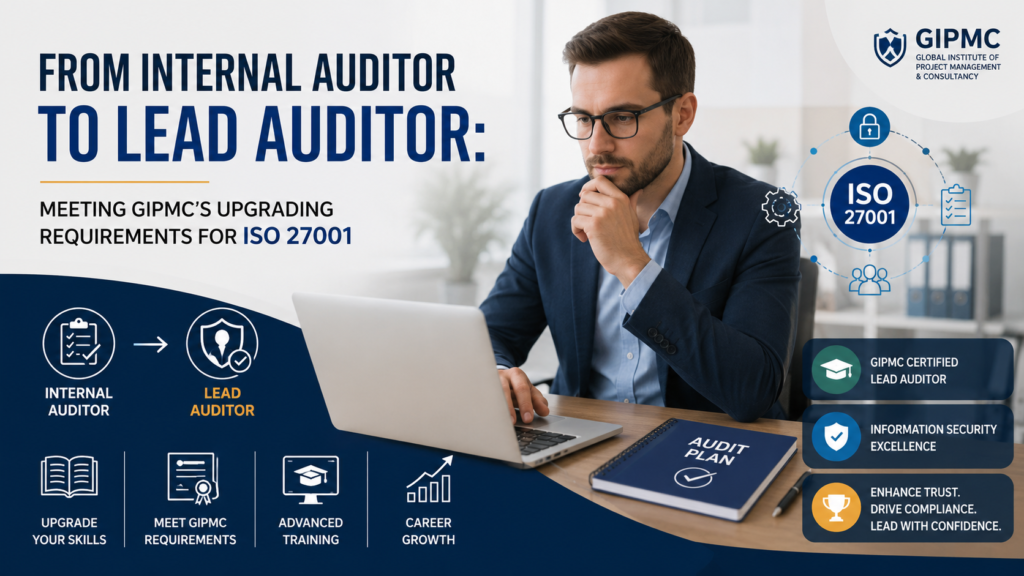
Your career move from internal to lead auditing will require broader audit leadership, risk evaluation, and reporting skills. An ISO 27001 certification can help you build a strong foundation and prepare you for higher-level ISMS audit responsibilities.
Key Takeaways
- Internal auditing will help you gain valuable ISMS knowledge and build key evidence-evaluation skills.
- Lead auditing includes additional team leadership, broader audit planning, and client-facing responsibilities.
- You should plan your ISO management certification pathway based on which lead auditor responsibilities you wish to pursue.
- Instead of assuming automatic credential upgrades, you must confirm current GIPMC progression requirements.
As an information security professional, moving from internal audits to lead auditor responsibilities can expand your career scope. An ISO 27001 certification at the internal-auditor level can help you establish the foundation, while you can continue valuable lead auditor training to develop the broader capabilities you will need to manage complete ISMS audits.
What Changes When You Move From Internal to Lead Auditor?
The main difference that you will notice after making this career progression is the scope of responsibility. With the GIPMC ISO/IEC 27001:2022 Internal Auditor credential, you will cover internal ISMS audit planning, conducting, reporting, evidence-based evaluation, and follow-up.
On the other hand, the ISO/IEC 27001:2022 Lead Auditor credential will help you go a few steps further, covering audit planning, management, execution, closure, team leadership, risk-based auditing, governance, and continual improvement.
| Career Stage | What You Build | Typical Responsibility | Best Next Step |
| Foundation | ISMS and security principles | Understand ISO 27001 concepts | Build standard knowledge |
| Internal Auditor | Evidence and audit execution | Audit your organisation’s ISMS | Gain practical audit exposure |
| Experienced Internal Auditor | Risk and finding evaluation | Identify weaknesses and nonconformities | Strengthen audit judgement |
| Lead Auditor Candidate | Audit planning and coordination | Prepare for broader audit leadership | Pursue lead auditor training |
| Lead Auditor | Team and audit leadership | Lead complete ISMS audits | Develop leadership experience |
| Audit Manager | Programme oversight | Manage multiple audits or teams | Expand governance expertise |
Table 1: ISO 27001 Career Progression From Internal Auditing to Lead Auditing
You need to think of the Lead Auditor credential and the ISO management certification as more than simple higher-level certifications to add to your resume. You must use these credentials to develop skills and gain valuable knowledge that will help you perform the additional responsibilities you will have to encounter as a lead auditor.
How Can You Build the Foundation for an ISO 27001 Lead Auditor Pathway?
Before you progress from an internal auditor role to a lead auditor position, you need to build key capabilities that will empower you to handle the additional responsibilities that come with the new role. These capabilities include:
- ISO 27001 requirements: Understand the structure, purpose, and application of the standard.
- ISMS fundamentals: Connect information security objectives with organisational risk.
- Evidence evaluation: Learn to distinguish objective evidence from assumptions.
- Audit findings: Identify and clearly document nonconformities.
- Risk-based auditing: Understand how security risks influence audit priorities.
- Corrective action: Evaluate whether corrective actions address identified issues.
- Audit reporting: Communicate findings and conclusions accurately.
To ensure complete preparation and proper credibility for the new role, you should consider pursuing an ISO 27001 certification. This credential will help you gain the knowledge and key skills you will need for risk-based auditing, objectivity, evidence-based evaluation, and continual ISMS improvement.
To succeed in your new lead auditing role, you will also need to add a few complementary capabilities such as audit-team coordination, broader planning, governance oversight, stakeholder communication, and professional audit leadership. This is where GIPMC’s certification programs can help you specifically address these areas.
| GIPMC Certification | Best Starting Point | Main Focus | Career Application |
| ISO/IEC 27001:2022 Internal Auditor Certification | New ISMS auditors | Internal ISMS audits | Internal Auditor, ISMS roles |
| ISO/IEC 27001:2022 Lead Auditor Certification | Experienced auditors | Full ISMS audit leadership | Lead Auditor, Audit Manager |
| ISO/IEC 27001–27002 Lead Auditor Certification | Security-focused auditors | ISMS and control assurance | Security Audit, GRC |
| ISO/IEC 27000 Lead Auditor Certification | Broader ISMS professionals | ISO 27000 family auditing | Governance and assurance |
| ISO/IEC 27005 Lead Risk Manager Certification | Risk-focused professionals | Information security risk | Risk and compliance leadership |
Table 2: GIPMC ISO Certifications Supporting Different Information Security Career Goals
Remember, completing an ISO management certification does not automatically guarantee a career progression from an internal auditor role to a lead auditor position. You will also need to:
- Build ISO 27001 knowledge.
- Complete internal audit training and certification.
- Apply audit skills to real ISMS processes.
- Develop risk, evidence, reporting, and finding-writing experience.
- Strengthen audit planning and leadership capabilities.
- Review GIPMC’s current Lead Auditor eligibility requirements.
- Confirm whether any prior GIPMC credential provides progression benefits before enrolling.
This will help you maximize your chances for a successful career progression and ensure that you can achieve the maximum benefit from the ISO 27001 certification on your resume.
Final Verdict: Is Internal Auditor Certification the Right First Step?
When your goal is to build practical ISMS auditing capabilities before taking on broader audit leadership, choosing the right ISO management certification is a very important first step. The Internal Auditor credential will provide you with a relevant foundation, while the Lead Auditor certification will address your skill requirements for wider planning, management, team leadership, and audit execution responsibilities.
Are You Looking to Move From Internal Auditing to Audit Leadership?
Speak with a certification advisor today to confirm your current credential, experience level, and the appropriate ISO management certification pathway before pursuing Lead Auditor status.